Typical Tucson Price
Tree removal typically runs from $200 to $6,000, with the broad range reflecting everything from an accessible small tree to a large, complex removal.
Tucson Tree Service Co. uses tree size, species, condition, access, and urgency to estimate tree removal costs in Tucson. Most homeowners pay $400 to $1,800 for one mature tree, but difficult or very large removals can cost much more. This guide breaks down the ranges so you can compare a quote with the work involved.
Tree removal typically runs from $200 to $6,000, with the broad range reflecting everything from an accessible small tree to a large, complex removal.
Size, species, health, site access, and urgency are the five core variables behind a tree removal estimate.
Compare at least two insured tree service quotes and confirm whether cutting, chipping, debris haul-off, stump work, firewood removal, and any crane charge are included.
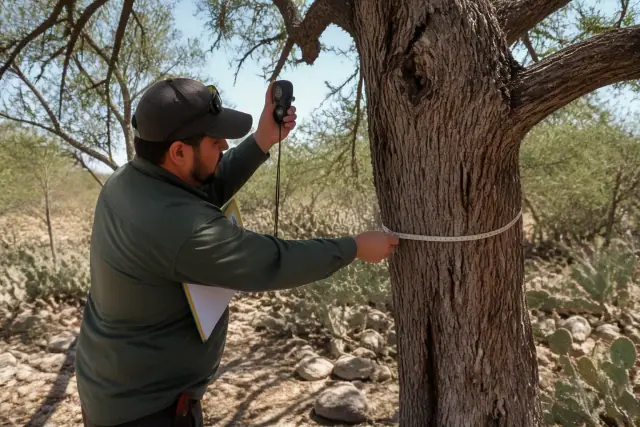
A crew measuring total tree height and the trunk across its cut face. A tree under 30 feet with a 12-inch trunk is usually simpler to section than a 60-foot tree.
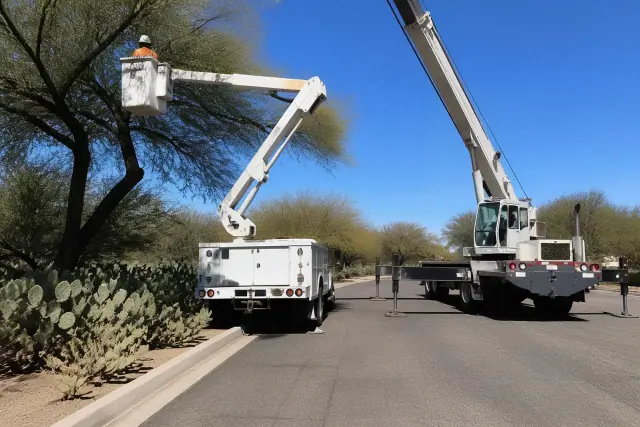
Compare an open curb-accessible tree with a mesquite over a Sam Hughes block wall or a backyard tree blocked by a narrow gate or pool. Limited equipment access can require hand-carrying sections or crane work and raise the quote.
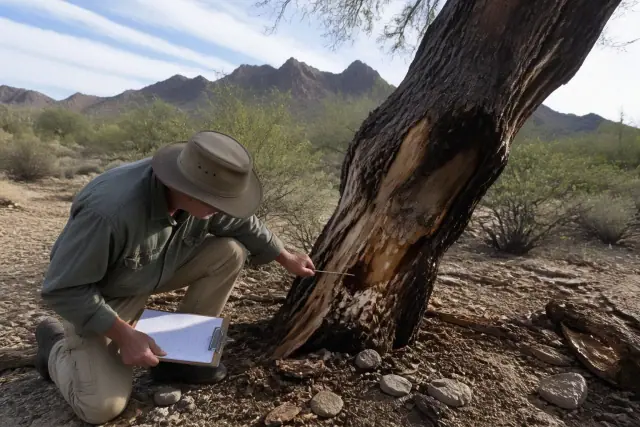
A stable canopy beside a split, leaning, or downed Aleppo pine near Reid Park after a Sonoran monsoon. Damage near a structure or utility calls for slower rigging and more controlled debris handling.
The most common single mature-tree removal falls between $400 and $1,800, while residential and commercial jobs across the metro typically land between $400 and $4,500.
Trees beside block walls, pools, power lines, or buildings need added safety time. A large saguaro near a Catalina Foothills foundation requires specialized handling, while a backyard tree without gate access may require a crane.
Dense mesquite, palo verde, and ironwood take longer to cut, while palms and saguaros need different handling. A 30- to 40-foot mesquite commonly runs $1,000 to $3,000 depending on canopy spread and trunk count, while established Aleppo pines and eucalyptus in older midtown neighborhoods may require extensive rigging.
Grinding typically costs $75 to $400 based on stump diameter. Pulling the full stump and root ball usually costs $150 to $500 depending on root spread.
| Tree size or example | Height | Typical Tucson cost |
|---|---|---|
| Small tree | Under 30 feet | $150 to $450 |
| Medium tree | 30 to 60 feet | $450 to $1,800 |
| Large tree | Over 60 feet | $1,800 to $6,000+ |
| Straightforward tree | 30 feet | $600 to $1,500 |
| Mesquite with a spreading or multi-trunk canopy | 40 feet | $1,800 to $4,200 |
| Pine requiring careful rigging | 60 feet | $3,000 to $5,000+ |
Why quotes vary: Dense wood, multiple trunks, limited access, rigging, crane work, and debris volume can move a tree beyond the listed range.
A tree removal quote can cover labor, equipment, insurance, cutting, chipping, standard debris hauling, and permit compliance where required. Most private residential removals in Tucson and unincorporated Pima County do not require a city or county permit, but HOA-governed neighborhoods on the east side and near the Oro Valley border may require written approval, especially in protected desert landscapes or view corridors. Stump grinding, firewood removal, and crane rental are often itemized separately. The work described here follows ANSI Z133 safety standards, ANSI A300 pruning standards, and ISA-recommended tree-risk practices.
Height and trunk diameter set the base scope, but canopy spread, multiple trunks, decay, root heave, and nearby structures affect how the tree can be sectioned. Two 30-foot trees on the same street can differ by $1,000 when one has open access and the other needs careful rigging. Standing dead trees may be easy to cut when the wood is brittle, yet instability near a house can add safety time. Work around utilities may also require coordination with Tucson Electric Power. After-hours 24/7 response during the July through September monsoon window usually costs more because crews must mobilize quickly and handle a high volume of debris.
For a tree around 30 to 40 feet tall with a roughly 12- to 18-inch trunk and good equipment access, a full removal may land near $1,000, although species and trunk count still matter. Late fall through winter, roughly November through February, tends to have lower demand than monsoon season. Keeping usable wood on site, clearing an access path, bundling stump grinding, and comparing quotes can reduce the total. A small to medium tree with good access often takes one to three hours; a large tree that needs rigging or crane work may take a half day to a full day. If removal is not necessary, two-person crew trimming averages around $130 per hour with typical jobs from $150 to $600, while structural or health pruning usually costs $100 to $400 per tree.
A free on-site estimate can account for tree height, trunk count, condition, equipment access, nearby structures, debris volume, and stump work before cutting begins.