Proudly serving Tucson, Oro Valley, Marana, Catalina Foothills, Casas Adobes, Sahuarita & surrounding areasCall or Text 24/7: 520-569-2093

Tree Planting & Desert Species Establishment in Tucson, AZ

Tucson Tree Service Co. provides professional tree planting for homes, HOAs, commercial properties, and schools across Tucson and the greater Pima County metro area. We handle species selection, site preparation, planting, staking when needed, and first-year establishment planning as one connected service. Our broader tree care work includes tree removal, trimming, pruning, stump grinding and removal, storm damage cleanup, palm trimming, cactus removal, and tree health consultations. Each recommendation is shaped around the property, from downtown infill lots to foothill sites and new construction near Vail.

New trees face surface soil temperatures above 140°F in July and about 12 inches of annual rainfall. Caliche often sits a foot or two below grade, while soil pH commonly runs from 7.5 to 8.5. Those conditions make drainage, planting depth, root preparation, and a species-specific watering plan essential. Our certified arborist staff evaluates those factors so the tree has a practical path to establishment in Tucson's desert climate.

Our process follows ISA guidance for root ball inspection, hole geometry, and backfill decisions. We work with 5-gallon and 15-gallon container stock as well as bare root specimens, and account for City of Tucson right-of-way and Tucson Electric Power clearance requirements when they apply.

Tucson Tree Service Co. provides professional tree planting throughout Tucson, Oro Valley, Marana, Sahuarita, and the greater Pima County metro area.

★ ★ ★ ★ ★4.9/5 Average Rating · 20+ Years of Experience · Thousands of Customers Helped · Licensed & Insured · Residential & Commercial

Tucson Tree Planting Benefits

What Does Professional Tree Planting Include?

Professional planting starts before a hole is dug. We source stock from Tucson-area growers whose trees are acclimated to the region's elevation, intense sun, and alkaline soil rather than selecting trees raised for very different climates.

A site walk considers sun exposure, drainage, existing irrigation, utility locations, mature canopy size, and the microclimate around walls and pavement. That information guides the species, stock size, and exact planting location.

Installation includes root ball inspection, correct hole depth, targeted backfill decisions, mulch placement, staking only where needed, and a first-year care plan. The goal is a tree that can extend roots into the surrounding native soil and establish beyond the nursery root ball.

Benefits of Professional Tree Planting

Correct species selection and installation give a new tree a stronger start in Tucson's demanding soil and climate. Strategic placement can also create useful shade, support a low-water landscape, and reduce avoidable conflicts as the canopy and roots mature.

  • Species matched to sun, soil, irrigation, and available space
  • Less transplant stress through appropriate stock selection
  • Drainage testing before roots are placed in caliche-prone soil
  • Correct root-crown depth for healthier gas exchange
  • Watering schedules matched to species and container size
  • Shade positioned for west- and south-facing walls
  • Clearance planned around utilities and rights-of-way
  • Long-term curb appeal and property value from a well-placed canopy
Planting Services

Professional Tree Planting Services

From a single native-tree replacement to multi-tree installations, each service addresses a specific part of successful establishment. The work is planned for Tucson's soil, heat, water limits, and built infrastructure.

Site Assessment & Species Selection

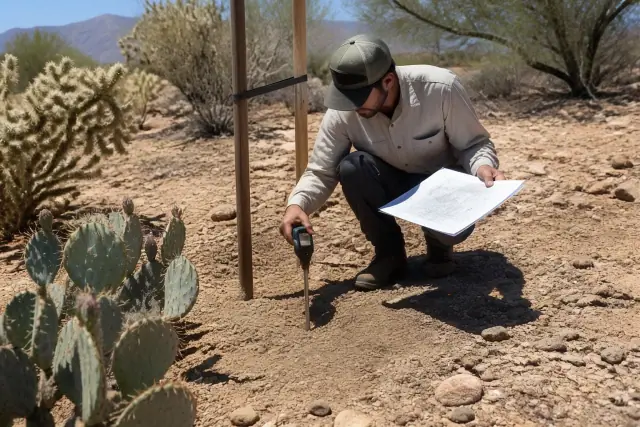
Arborist using a soil probe and field map to assess a planting site in a desert landscape in Tucson, AZ.

We evaluate sunlight, reflected heat, drainage, irrigation, nearby structures, and mature tree size before recommending a species. The selection is based on the property's microclimate rather than a one-size-fits-all list.

Request Estimate

Soil Preparation & Drainage Testing

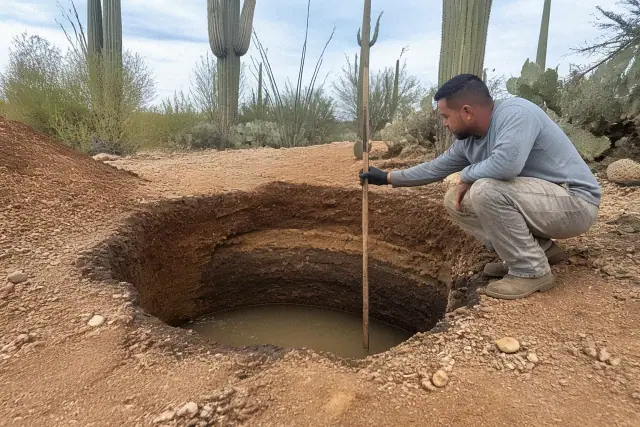
A technician testing soil drainage and preparing a hole for tree planting in a Tucson, AZ desert landscape.

The planting hole is filled and refilled with water to reveal drainage problems before the tree is set. Where caliche traps water, preparation focuses on restoring drainage without automatically over-amending the native backfill.

Request Estimate

Root Ball Inspection & Proper Planting

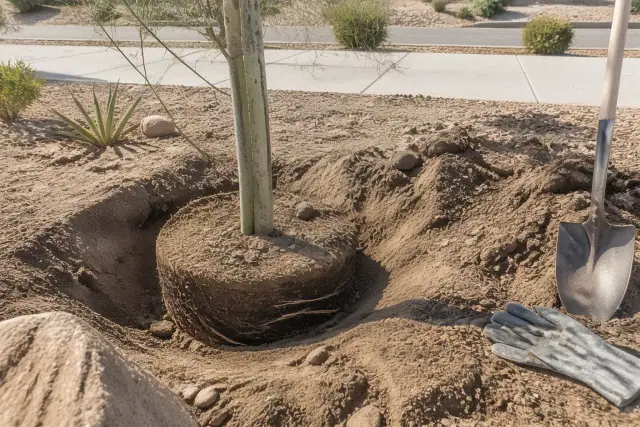
A root ball of a newly planted tree being backfilled with soil in a desert landscape in Tucson, AZ.

We inspect the root ball, dig to the correct width and depth, and position the root crown at or slightly above grade. The tree is set slightly high to allow for settling instead of being buried in the hole.

Request Estimate

Staking & Wind Support

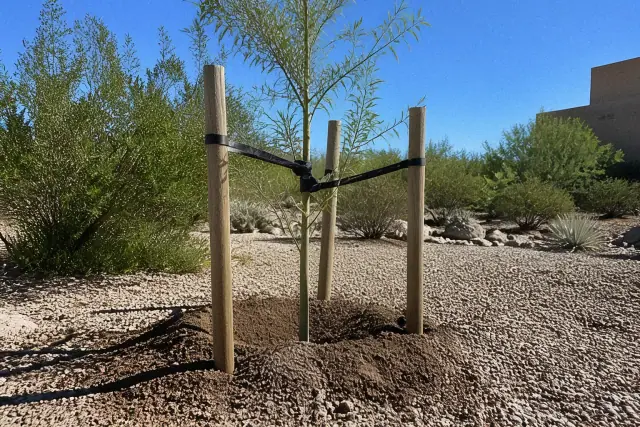
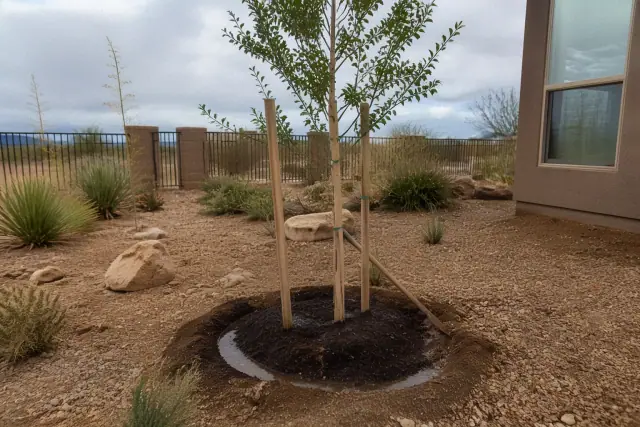
Young tree with three wooden support stakes and rubber ties in a desert landscape in Tucson, AZ.

Stakes and guy wires are used only when wind exposure or root ball size makes support necessary. They are positioned to stabilize the tree without becoming a permanent substitute for trunk strength.

Request Estimate

Watering & Establishment Planning

Technician backfilling soil around a newly planted young tree in a Tucson, AZ residential yard.

Each installed tree receives a watering schedule matched to its species and container size. The plan accounts for Tucson's seasonal heat and helps encourage deeper roots rather than shallow growth from frequent surface watering.

Request Estimate

Multi-Tree Planting Projects

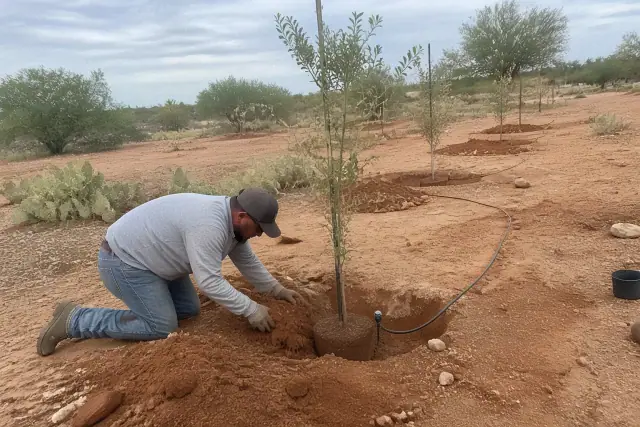
A technician backfilling soil around a newly planted tree at a landscaping job site in Tucson, AZ.

We plan multi-tree installations for HOA common areas, school campuses, commercial sites, residential properties, and new subdivisions. Coordinating site preparation and mobilization in one visit can reduce the per-tree cost compared with separate service calls.

Request Estimate
Species & Stock Options

Trees for Tucson Landscapes

The right choice depends on the purpose of the tree, the site's exposure, permanent irrigation, mature size, and how quickly shade is needed. These options cover native species, shade priorities, nursery stock sizes, xeriscapes, and larger planting programs.

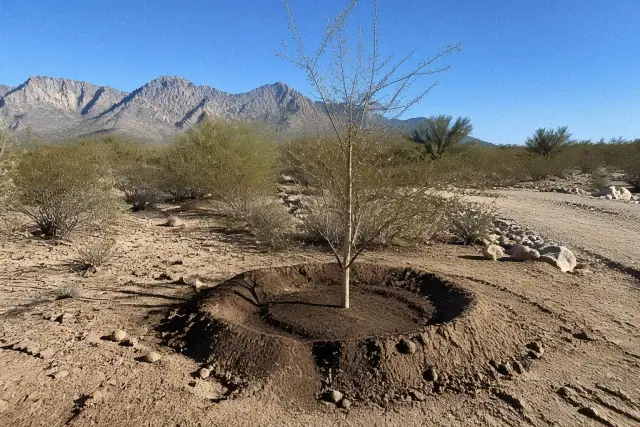
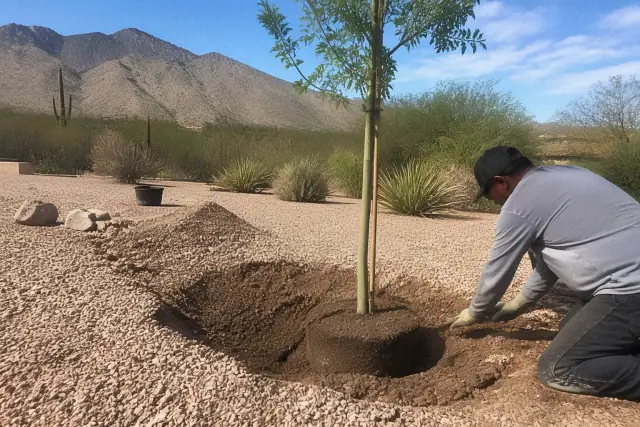
Newly planted saplings in desert soil with Santa Catalina mountains in the background in Tucson, AZ.

Native Desert Trees

Palo verde, mesquite, ironwood, and desert willow are adapted to Tucson's rainfall pattern and alkaline soil. They generally establish with less long-term intervention than ornamentals developed for wetter climates.

  • Palo verde tolerates alkaline soil and natural rainfall once established
  • Native mesquite can live over a century in undisturbed desert conditions
  • Urban mesquite often lives roughly 50 to 75 years under compacted soil and irrigation
  • Ironwood grows slowly but can develop into a long-lived canopy tree
  • Desert willow and acacia offer faster growth and seasonal blooms
Request Estimate
Technician planting a young shade tree with staking and mulch at a Tucson, AZ job site.

Heat-Tolerant Shade Trees

Palo verde and desert willow are frequent choices for shade over patios and driveways because they tolerate reflected heat from masonry and pavement. Placement should balance useful canopy with the tree's mature clearance needs.

  • Shade for patios and outdoor living areas
  • Canopy positioned near west-facing walls
  • Relief from reflected heat beside driveways
  • Species selected for sun and permanent irrigation
  • Mature size checked against buildings and utilities
Request Estimate
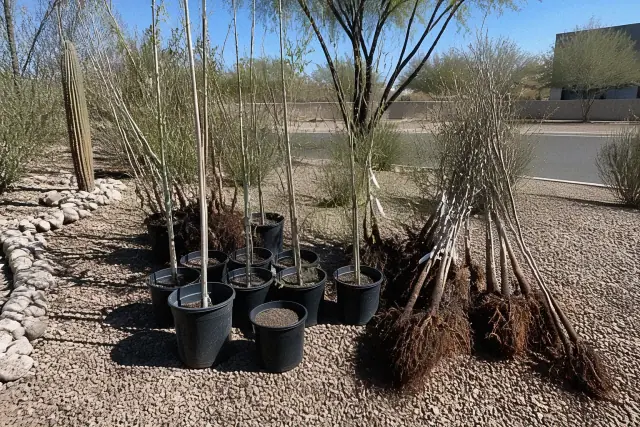
Young trees in nursery containers and bare root specimens ready for planting on a job site in Tucson, AZ.

Container and Bare Root Stock

Stock size affects transplant stress, handling, establishment speed, and price. A correctly planted smaller tree can outperform larger stock when its root system adapts quickly to the surrounding soil.

  • 5-gallon trees for a smaller root ball and easier establishment
  • 15-gallon trees when a larger starting size is appropriate
  • Bare root specimens where species and season allow
  • Smaller stock can experience less transplant shock
  • Larger stock may suit storm-damaged shade-tree replacement
Request Estimate
A technician planting a low-water tree in a xeriscape garden with crushed granite in Tucson, AZ.

Xeriscape and Low-Water Trees

Native desert trees fit naturally into xeriscape and low-water landscape plans. Once established, they typically need supplemental water mainly during extended dry spells, while many non-native shade trees require permanent drip irrigation.

  • Native species adapted to alkaline soil
  • Lower supplemental water needs after establishment
  • Choices aligned with Pima County low-water guidance
  • Permanent irrigation needs identified before planting
  • Species matched to xeriscape design goals
Request Estimate
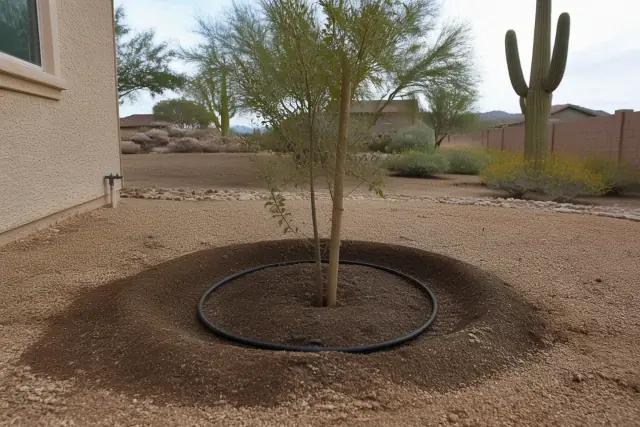
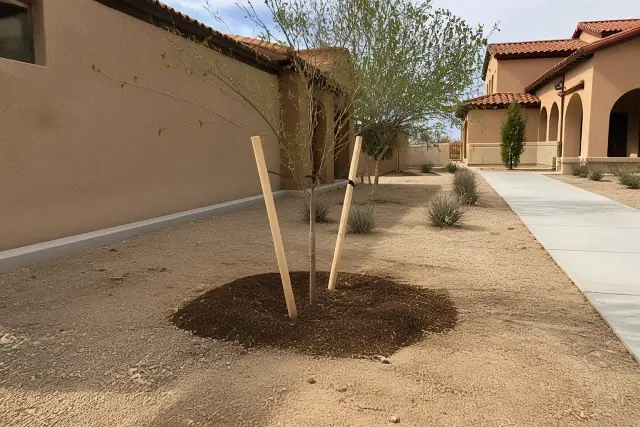
Newly planted sapling with fresh mulch in a Tucson, AZ landscape with stucco buildings and dry desert soil.

Community and Multi-Property Plantings

Larger planting plans require consistent site assessment without treating every spot as identical. We adapt species, spacing, and establishment care across campuses, common areas, developments, and commercial grounds.

  • HOA common-area planting
  • School campus beautification projects
  • Commercial property installations
  • New subdivision tree plans
  • Multi-tree residential projects
Request Estimate
Finding the Right Fit

Choosing the Right Planting Approach

A planting plan should connect the tree's mature height and canopy to the site's sun, drainage, irrigation, soil, utilities, and desired shade. We weigh those factors together so stock size, species, placement, and care requirements support the same long-term goal.

Desert-Specific Site Planning

Recommendations account for caliche, alkaline soil, intense reflected heat, limited rainfall, and large temperature swings between planting seasons. That local context helps avoid choices that work at the nursery but fail at the property.

ISA-Guided Planting Methods

Our planting process follows ISA guidance for inspecting the root ball, shaping the planting hole, and deciding how to handle backfill. These details encourage roots to move outward into native soil instead of remaining confined.

First-Year Care Plans

Every installation includes a care plan with watering guidance matched to the tree's species and container size. Mulch and temporary staking recommendations are included where site conditions call for them.

Built for Desert Conditions

Why Choose Us for Tree Planting Services?

Tucson Tree Service Co. connects species selection, soil and drainage preparation, utility awareness, correct installation, and establishment care in one plan. You receive a site-specific recommendation instead of a generic planting handout.

Request Site Assessment

Caliche-Blocked Drainage

A calcium-carbonate caliche layer often sits a foot or two below grade and can block both drainage and root penetration. Water trapped above that hardpan can drown new roots even in a desert climate.

Extreme Heat and Low Rainfall

July surface soil can exceed 140°F while Tucson receives only around 12 inches of rain in an average year. A new tree needs careful timing, mulch, and an establishment watering plan to bridge that gap.

Planting Too Deep

When the root crown is buried below grade, roots can lose needed oxygen and the tree may decline slowly over one to three years. Setting the crown at or slightly above grade helps prevent this common installation failure.

Wrong Species or Site

A tree selected without mature size, reflected heat, irrigation, or canopy goals in mind can outgrow its space or struggle to establish. Matching the species to the microclimate prevents a nursery choice from becoming a long-term property problem.

Utility and Root Conflicts

Roots, trunks, and canopies need room away from sewer, water, other buried utilities, overhead power lines, and rights-of-way. Planning for the tree's mature dimensions helps prevent pipe intrusion, forced pruning, or later removal.

Poor Establishment Watering

Generic or shallow watering can leave roots near the surface, while standing water in poorly drained soil can suffocate them. The schedule must reflect species, stock size, soil drainage, season, and Tucson's heat.

How It Works

Our Tree Planting Process

The process moves from site conditions to species selection, installation, and establishment care. Each step is intended to reduce transplant stress and avoid problems that are difficult to correct after the tree is in the ground.

01.

Site Walk and Goals

We review the desired shade, screening, curb appeal, or replacement purpose and inspect sun exposure, existing irrigation, access, structures, and utility locations.

02.

Drainage and Soil Assessment

We evaluate soil texture and caliche, then fill and refill the proposed hole with water to see whether drainage is adequate before setting the tree.

03.

Species and Stock Selection

Species, mature size, water needs, and 5-gallon, 15-gallon, or bare root stock are compared against the site's microclimate and the owner's timeline for canopy.

04.

Prepare the Hole and Root Ball

The hole is dug two to three times as wide as the root ball but no deeper than the root crown. We inspect the root ball and break through drainage barriers where site conditions require it.

05.

Plant, Backfill, and Mulch

The root crown is set slightly high for settling, and backfill stays close to the native soil texture. Mulch is placed three to four inches deep around the base while remaining clear of the trunk.

06.

Watering Plan and Support

We provide a species- and stock-specific watering plan and install stakes only where exposure requires them. Supports are removed once the trunk can stand on its own, typically within one growing season.

Plant With a Plan

Schedule a Tucson
Tree Planting
Consultation

Request a site-specific estimate for a new tree, a storm-damaged tree replacement, or a multi-tree property plan. We will review the site conditions, planting goals, stock options, and establishment needs before recommending an approach.

Tree Planting Help

Tucson Tree Planting FAQs

These answers cover Tucson tree selection, timing, costs, planting depth, utility spacing, stock sizes, watering, and community planting programs.

Call About Tree Planting

There is no single best tree for every site. Palo verde, mesquite, ironwood, and desert willow are strong native options because they fit Tucson's rainfall pattern, alkaline soil, and summer heat; the final choice should account for sun, irrigation, mature size, and the amount of shade wanted.

It is an overhead-line spacing guide based on mature tree height. Trees under 25 feet tall need at least 10 feet of clearance, trees up to 40 feet need at least 20 feet, and trees over 40 feet need at least 30 feet of setback from overhead power lines.

Fall from October through early December is the strongest window, followed by late winter into early spring. The broader October-through-March cool season reduces transplant stress, while roots grow best at roughly 65 to 85°F soil temperatures before peak summer heat arrives.

Arizona project costs can range roughly from $1,000 to $8,000 depending on tree size, species, access, soil preparation, and total scope, with most single-tree residential installations well below the high end. A basic 5-gallon tree from a local nonprofit distribution program may cost around $30 for the tree alone; professional planting, staking, and first-season care add labor and materials. Planting five trees in one coordinated visit generally costs less per tree than arranging five separate service calls.

Planting too deep is the most common failure we see. A buried root crown can cause slow decline over one to three years, while heavily amended backfill can keep roots from extending into native soil. The root crown should sit at or slightly above grade.

Test drainage first so caliche does not trap water around the roots. Dig two to three times wider than the root ball but no deeper than the root crown, set the tree slightly high, use backfill close to the native soil texture, and spread mulch three to four inches deep without touching the trunk.

Keep trees at least 10 feet from sewer lines, at least 5 feet from water lines, and at least 3 feet from other underground utilities such as gas and communication conduit. Overhead power lines also require spacing based on the tree's mature height.

The best stock type depends on species, season, access, budget, and how quickly canopy is needed. A correctly planted 5-gallon tree may establish faster and outgrow a poorly planted 15-gallon tree because the smaller root system can experience less transplant shock; larger or bare root stock can still be appropriate in the right setting.

New trees need an establishment schedule matched to species, container size, soil drainage, and season. Once established, native desert trees typically need supplemental water mainly during extended dry spells, while non-native shade trees may require permanent drip irrigation.

Summer planting is possible, but it brings more transplant stress and requires intensive watering plus shade protection during establishment. We generally advise waiting for cooler weather unless planting follows storm damage or tree removal.

Caliche is a hard calcium-carbonate layer that often sits a foot or two below grade in the Tucson valley. It can stop roots and trap water, so drainage should be tested and any barrier addressed before the tree is set.

No. Staking and guy wires are used only when wind exposure or root ball size requires support. They should be removed after the trunk can support itself, typically within one growing season.

The City of Tucson's Million Trees initiative aims to plant one million trees by 2030, with planting sessions running from October through March. Tucson Clean and Beautiful's Trees for Tucson program distributes 5-gallon trees from regional nurseries to residents, HOAs, and schools, often for around $30 per tree. Eligible utility workshop participants may also qualify for discounted or free saplings.